
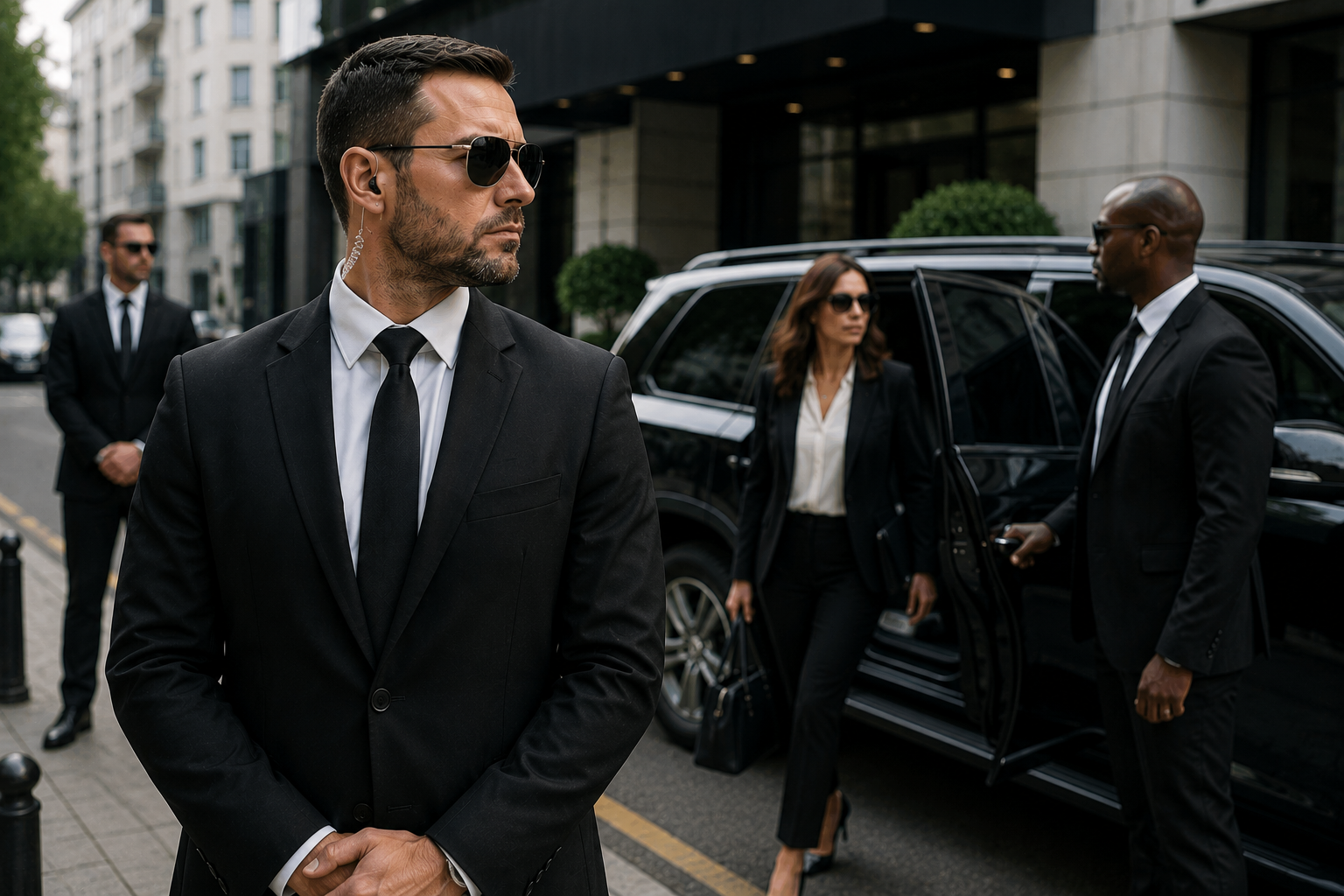
Knowing how to hire a bodyguard UK clients can rely on is simpler than most people assume, but there are important decisions to get right before you commit to a close protection officer. This guide covers everything you need to know: what to look for, what to expect to pay, how the process works, and how to avoid the mistakes that lead to poor outcomes.
Security and Safety Solutions is a UK close protection and risk consultancy led by Tom Richmond, a former British Army Royal Military Police Close Protection Officer with over 20 years of operational experience. The advice below reflects how professional engagements actually work, not how they are marketed.
Do You Actually Need a Bodyguard?
The first question when learning how to hire a bodyguard UK is whether close protection is the right solution for your situation. Close protection is one tool within a broader security spectrum. For some clients, a risk assessment or a security consultancy review is the right starting point, identifying whether the threat level justifies the cost of a close protection officer or whether other measures, such as vehicle security, residential security, or changes to your routine, would be more proportionate.
Clients who typically engage a bodyguard in the UK include high-net-worth individuals and their families, corporate executives during travel or public appearances, visiting dignitaries and international clients, individuals who have received credible threats, and celebrities or public figures during events. However, close protection is not exclusive to high-profile clients. Anyone facing a credible, specific threat can benefit from professional protective cover, regardless of public profile.
SIA Licensing: The Non-Negotiable Starting Point
In the UK, anyone working as a close protection officer must hold a valid Security Industry Authority (SIA) Close Protection licence. This is a legal requirement under the Private Security Industry Act 2001. Hiring an unlicensed bodyguard exposes you to significant legal risk and, more importantly, means your protection is being provided by someone who has not been formally vetted or trained to the national standard.
When evaluating any close protection officer or security company, ask to see their SIA licence number and verify it on the SIA public register. A reputable company will provide this without hesitation. You should also check that the company carries appropriate professional indemnity and public liability insurance.
Beyond the SIA licence, look for additional qualifications: advanced driving (BTEC Level 3 or equivalent), emergency first aid, surveillance awareness and counter-surveillance training. For higher-risk engagements, medical training to a higher level, such as trauma care, is increasingly standard.
Military and Police Background: Does It Matter?
Many of the most experienced close protection officers in the UK come from a military or police background, and for good reason. Military close protection training, particularly from the Royal Military Police, provides operational experience in high-pressure, high-consequence environments that civilian training courses cannot replicate.
A military or police background is not the only route to excellence in close protection, but when assessing providers, it is a useful signal of depth of experience. Ask about operational history, the environments they have worked in, and the types of principal they have protected.
Technical skills matter as much as background. The best close protection officers combine operational experience with discretion, communication skills, and the ability to blend into environments ranging from corporate boardrooms to high-end private events. Visible aggression or intimidating demeanour is rarely appropriate and often counterproductive.
How Much Does a Bodyguard Cost in the UK?
Day rates for close protection in the UK typically range from £300 to £800 per officer, depending on experience level, the nature of the assignment, and geography. London and South East engagements tend to sit at the higher end of that range.
For longer engagements or 24/7 residential cover, costs are scoped on a weekly basis. A two-officer rotation providing round-the-clock protection typically starts from £5,000 per week. Event security assignments for a single officer at a private function start from around £200 to £300, depending on duration and requirements.
These figures reflect professional, fully vetted SIA-licensed officers at the quality end of the market. Cheaper options exist, but the gap between a £150-per-day bodyguard and a £600-per-day close protection officer reflects real differences in training, vetting, experience, and capability. For anything other than the most basic requirement, the cheapest option is rarely the right one.
Most professional close protection providers will provide a fixed quote for a defined scope of work rather than an open-ended daily rate. This gives you budget certainty and aligns the provider’s incentives with delivering a clear outcome. See our full pricing guide for more detail.
What Happens Before the Assignment Starts
A professional close protection engagement does not begin with a bodyguard arriving at your door. It begins with a threat and risk assessment. Understanding this process is central to how to hire a bodyguard UK effectively.
Before any protection is deployed, your provider should understand who you are, why you may be at risk, what specific threats or concerns have prompted the request, your normal routines and movements, the venues, events, or travel involved, and any special considerations for your household or business.
This assessment informs the protective security plan: how many officers are needed, whether advance work is required at venues, what vehicles and communications are appropriate, and whether any residential or digital security measures should be considered alongside the physical protection.
Skipping this step, or working with a provider who skips it, is a significant red flag. Generic protection deployed without a proper threat assessment is expensive, often excessive in some areas and inadequate in others, and unlikely to be proportionate to the actual risk.
Choosing Between a Security Company and an Independent Operator
Most people deciding how to hire a bodyguard UK will choose between a specialist security company and an independent operator who works directly for clients. Both models have advantages.
A specialist company provides a single point of accountability, insurance cover, the ability to staff larger or more complex assignments, and continuity if a specific officer is unavailable. The best companies also provide strategic input at the consultancy level, helping clients think through their overall security posture rather than just filling a staffing requirement.
Independent operators often have deep experience in specific sectors or environments and can provide a more personal, consistent service for long-term principal relationships. The risk is that vetting, insurance, and continuity arrangements sit entirely with the individual.
For most clients, a specialist company offering a named officer for the engagement, with clear accountability and documented insurance, represents the better overall risk position.
Discretion and Integration
One of the most common concerns clients raise before their first close protection engagement is visibility. Will having a bodyguard make them look like a target? Will it disrupt meetings or family life?
Skilled close protection officers are trained to operate at whatever level of visibility the assignment requires. Corporate and private clients in the UK almost always prefer a low-profile approach, with the officer operating as a driver, an assistant, or simply a companion rather than a uniformed guard. The best close protection officers are, in a professional sense, invisible. Your security should enhance your freedom of movement, not constrain it.
UK Coverage: London and the South of England
Most close protection demand in the UK is concentrated in London, where the density of high-net-worth individuals, international visitors, corporate headquarters, and public events creates a constant need for professional protective cover. Our London bodyguard services cover the full capital, including Mayfair, Knightsbridge, Belgravia, the City, and all major venues.
Within London, we provide dedicated coverage across Mayfair, Knightsbridge, Belgravia, Chelsea, Kensington, Notting Hill, and the City of London, as well as all major venues and transport hubs across the capital.
Beyond London, we cover the full South of England including Surrey, Sussex, Hampshire, Berkshire, Oxfordshire, Kent, Buckinghamshire, Hertfordshire, and Bristol and the South West. In the North of England we cover Greater Manchester, Yorkshire, and Cheshire. The Midlands are covered through our West Midlands and East Midlands teams. We also serve clients across Essex and the wider East of England. We cover Liverpool and Merseyside. We also cover the North East of England (Newcastle, Sunderland, Durham) and East Anglia (Norfolk, Suffolk, Cambridgeshire). We operate UK-wide including Scotland, Wales, the South West of England, and Northern Ireland. For international assignments, we scope each engagement on its merits.
Common Questions
How quickly can a bodyguard be arranged?
For straightforward assignments with a defined scope, we can typically confirm cover within 24 to 48 hours. Same-day cover is possible in some circumstances but depends on officer availability and the complexity of the requirement.
Can I hire a bodyguard for a single day?
Yes. Single-day and single-event engagements are a standard part of what we do. The minimum engagement is typically a full day (ten hours), though we can discuss shorter assignments where appropriate.
Will my bodyguard be armed?
In the UK, civilian close protection officers do not carry firearms. This is a legal restriction, not a capability limitation. UK close protection is built around protective movement, route planning, advance work, and risk mitigation rather than armed response.
How do I start the process?
The best starting point is a confidential conversation. Call us on 07939 532682 or use our contact form. All initial conversations are free and without obligation. We will ask a few questions about your situation and can usually give you an initial assessment and indicative cost within the same call.
Related Services
- Event Security Services - Professional event security and crowd management
- International Close Protection - Specialist protection services for international clients
Last reviewed: June 2026
About the author
Tom Richmond is a safety and security subject matter expert with sixteen years of international consultancy and management experience. He served for seven years as a commissioned Army Officer in the Royal Military Police.
His qualifications include the NEBOSH Level 6 Diploma in Occupational Health and Safety, a Level 7 Diploma in Security Management, and a Level 5 Diploma in Leadership and Management. He is also an IFSM Fire Safety Professional and an HSE trained Principal Designer.
Contact Security and Safety Solutions for a confidential consultation.
We’re here to support you
We appreciate that most people haven’t used security services before, so we’ll support you every step of the way so that we fully understand the risk to you, and then provide you with a bespoke solution.
We are contactable 24/7 if you need us, we’re happy to come out and meet you for an introductory meeting, or if a conference call is easier, we’ll fit in around your schedule.
Get in contact now and we’ll talk you through potential options to improve your safety and security.

