
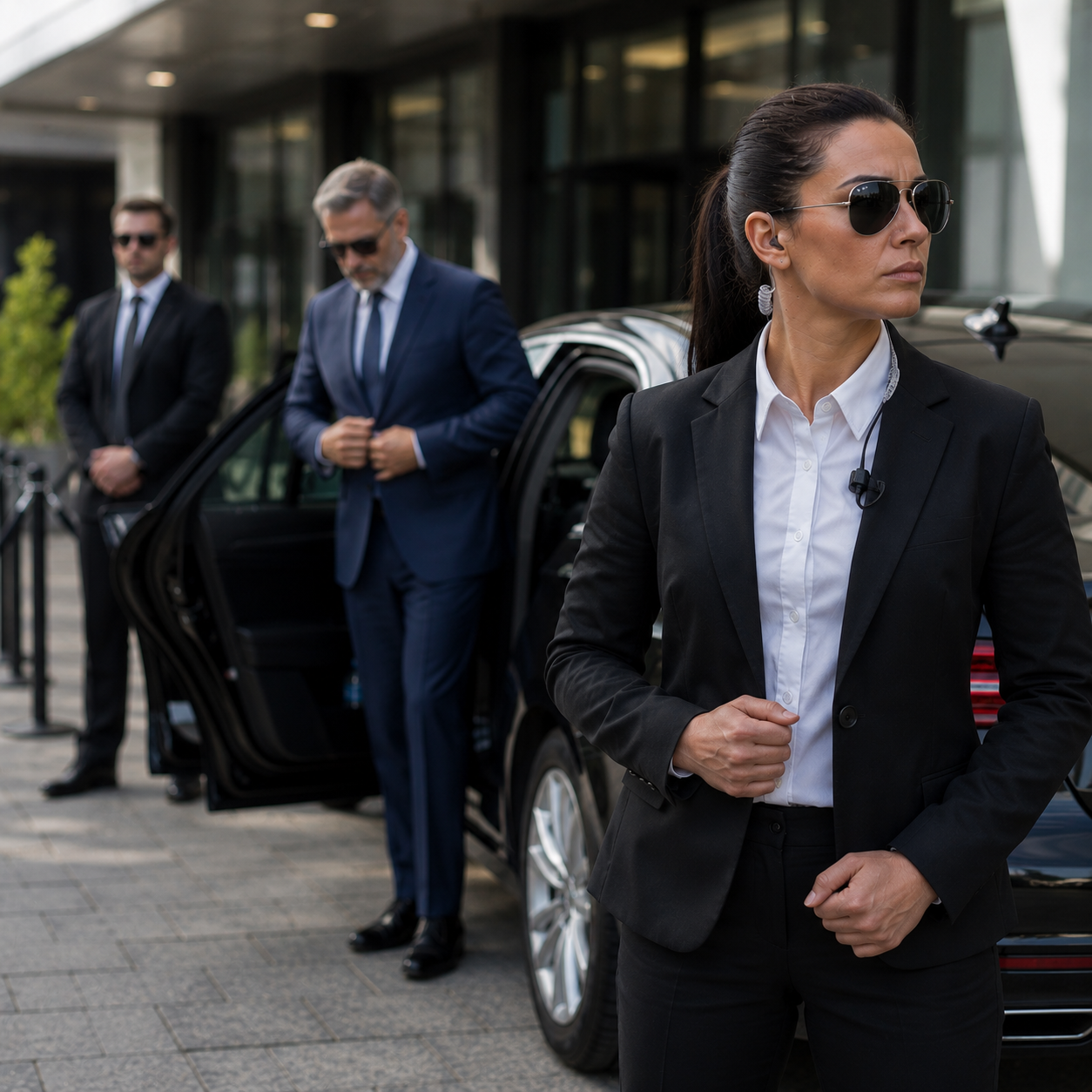
A close protection officer (CPO) is a trained, licensed security professional whose job is the physical safety of one specific person, known as the principal. Unlike a security guard, who protects a fixed location, a close protection officer’s brief moves with the person. Instead, they plan and manage the security of every journey, venue, event and environment the principal enters. In short, this guide explains what a close protection officer does, the skills and training involved, and what to expect if you engage one.
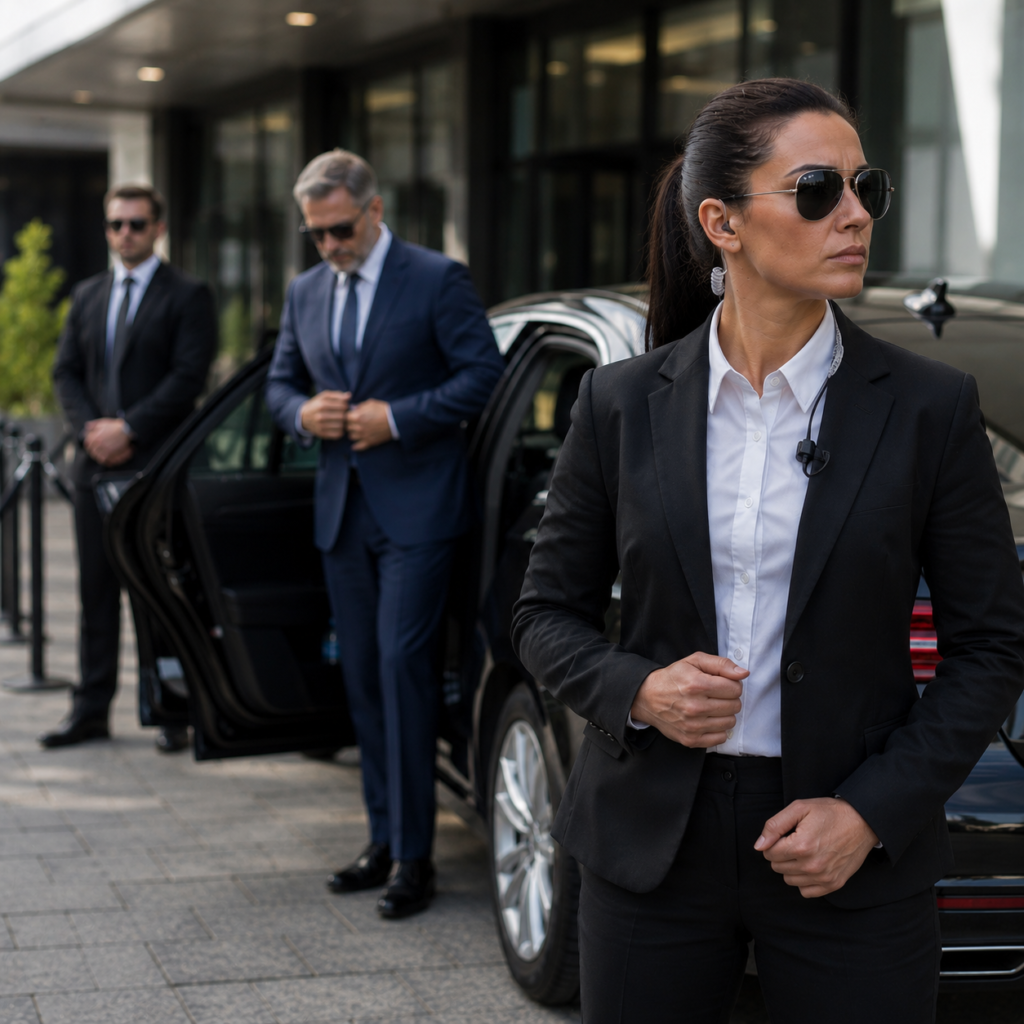
The term is often used interchangeably with “bodyguard”. However, close protection officer is the professional standard used across the UK security industry, the SIA licensing framework and the international qualification pathway. For the everyday distinction, see our guide on bodyguard or security guard.
What does a close protection officer do?
The work falls into two categories: preparation and execution.
Preparation: advance work
Before any significant movement, the officer conducts advance work. Specifically, that means visiting venues ahead of time, identifying secure entry and exit points, planning primary and contingency routes, reviewing the threat environment and agreeing emergency protocols. For high-risk or unfamiliar environments, advance work often takes longer than the protected event itself. Consequently, an officer who does not do advance work is not providing professional close protection.
Execution: the protective detail
During the operation, the officer holds a protective position calibrated to the environment. For example, in a controlled private setting that may be at a distance. In contrast, in an unpredictable public space it will be closer. Meanwhile, they monitor the surroundings, manage access to the principal, coordinate with any supporting team and maintain communications discipline.
Logistics and coordination
Beyond physical protection, a professional close protection officer manages significant logistics: coordinating drivers and ground transport, liaising with venue security, adjusting the schedule in real time and communicating with family, PAs or corporate security functions. For a first-hand account of a real assignment, read a day in the life of a close protection specialist.
Close protection officer skills
Technical training is only the baseline. The skills that separate a good officer from an average one are judgement, communication and discretion. For instance, a skilled officer reads a room quickly, makes decisions under pressure without drama, and speaks to a chief executive or a hotel doorman with equal ease. Similarly, they blend into corporate boardrooms and private events alike. By contrast, visible aggression is rarely appropriate and usually counterproductive. The best officers are, in a professional sense, invisible.
What qualifications does a UK close protection officer need?
In the United Kingdom, anyone providing close protection as a paid service must hold a Close Protection licence from the Security Industry Authority. Importantly, this is a legal requirement under the Private Security Industry Act 2001. Working without one is therefore a criminal offence.
To obtain the licence, a candidate completes an Ofqual-regulated Level 3 Certificate for Working as a Close Protection Operative, passes identity and criminal record checks, and must be assessed as fit and proper. In addition, the training covers threat and risk assessment, advance work, surveillance awareness, protective foot and vehicle drills, first aid and conflict management. Since 2021 it also includes a first aid at work qualification as a prerequisite.
Additional qualifications to look for
Many professional officers hold more than the baseline. Common additions include the ASIS Certified Protection Professional (CPP), the global standard in security management; NEBOSH health and safety qualifications, relevant to risk assessment and safe systems of work; advanced or protective driving awards for officers who also provide secure transport; and enhanced medical training such as trauma care. Each one signals professional development beyond the legal minimum.
Military and police background
Historically, most experienced UK close protection officers come from a military or police background. Military close protection training is delivered by the Royal Military Police, and officers who have passed it bring operational discipline that civilian courses alone cannot replicate. Likewise, former Royal Military Police close protection operators, UK Special Forces, and Metropolitan Police Royalty and Specialist Protection officers represent the highest tier of background in the UK.
Nevertheless, a military or police past is not the only route to excellence. When reviewing credentials, ask what operational environments the individual has actually worked in, not just which courses they have completed.
What is it like to work with a close protection officer?
A professional officer is trained to be unobtrusive. As a result, most clients describe the experience as a reassuring presence that does not disrupt normal life, social interaction or business. First, at the start of an engagement, a good officer briefs the principal on what to expect: how to respond if asked to move quickly, how to communicate during a venue visit, and what information the team needs about the itinerary. For principals who have not worked with an officer before, the adjustment period is short. Typically, after a day or two, the presence becomes comfortable and unremarkable.
When do you need a close protection officer?
Not everyone at risk needs full-time cover. Rather, the question is whether the level and nature of the risk justify the investment, and whether other measures would be more proportionate. A security risk assessment is the starting point. For some clients, awareness training and procedural changes are enough. Others need an officer on specific high-risk occasions. Finally, a small number justify full-time cover.
For example, common triggers include a specific and credible threat, a period of elevated public exposure such as a major announcement or legal matter, travel to an unfamiliar or higher-risk environment, or a pattern of minor incidents that together suggest sustained targeting.
Common questions about close protection officers
How much does a close protection officer cost in the UK?
Between £350 and £1,000+ per day depending on experience, risk and location. Generally, most London assignments sit between £400 and £650. See our full cost guide.
Are close protection officers armed in the UK?
No. Civilian officers do not carry firearms. Instead, protection relies on planning, movement and awareness. Read more on armed security in the UK.
How do I become a close protection officer?
Complete the Level 3 close protection qualification with an approved training provider, hold a current first aid at work certificate, then apply to the SIA for your licence. Our article on close protection jobs covers the realities of the career.
Finding the right close protection officer
The UK market includes a very wide range of operators. Above all, the factors that matter most are verifiable SIA licensing, genuine operational experience rather than training alone, credible references from comparable assignments, and a clear approach to advance work. Security and Safety Solutions provides close protection across London and the South of England, led by Tom Richmond, a former commissioned officer in the Royal Military Police who holds a Level 7 Diploma in Security Management. Consequently, we begin every engagement with an independent threat and risk assessment. To discuss a requirement, contact us.
Last reviewed: September 2026
About the author
Tom Richmond is a safety and security subject matter expert with sixteen years of international consultancy and management experience. He served for seven years as a commissioned Army Officer in the Royal Military Police.
His qualifications include the NEBOSH Level 6 Diploma in Occupational Health and Safety, a Level 7 Diploma in Security Management, and a Level 5 Diploma in Leadership and Management. He is also an IFSM Fire Safety Professional and an HSE trained Principal Designer.
Contact Security and Safety Solutions for a confidential consultation.
We’re here to support you
We appreciate that most people haven’t used security services before, so we’ll support you every step of the way so that we fully understand the risk to you, and then provide you with a bespoke solution.
We are contactable 24/7 if you need us, we’re happy to come out and meet you for an introductory meeting, or if a conference call is easier, we’ll fit in around your schedule.
Get in contact now and we’ll talk you through potential options to improve your safety and security.

